

News & Insights
Interested in starting a new business in Egypt?
Soliman, Hashish & Partners is constantly in the media spotlight!
Scholarship for studying the Master of Laws in International Trade Law at International Training Centre of ILO
All Categories
- Insights (149)
- Firm News (71)
- CSR (10)
- COVID-19 (2)
- Briefings (76)
- Projects & Construction (1)
- Antitrust (1)
- Banking & Finance (21)
- Corporate (21)
- Corporate Crimes (3)
- Dispute Resolution (5)
- Employment (4)
- Energy & Electricity (2)
- Intellectual Property Rights (1)
- Mergers & Acquisitions (2)
- Real Estate (2)
- Telecoms, Media & Technology (15)
- Uncategorized (1)
Recent News





Construction Law in Egypt: SH&P Contributes to Lexology Panoramic 2027
Partner in charge
Mohamed Hashish
Managing Partner
Overview of Construction Law in Egypt
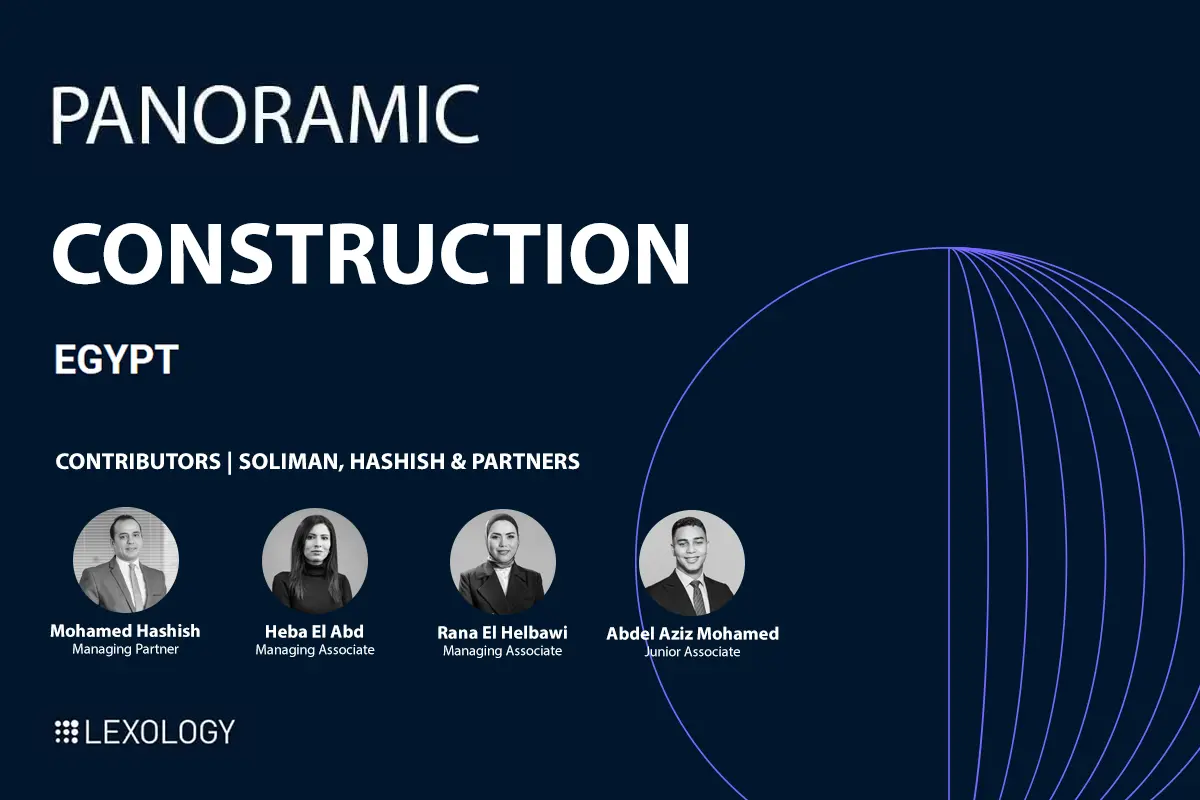
Soliman, Hashish & Partners has contributed the Egypt chapter to Lexology Panoramic – Construction 2027, providing a practical overview of construction law in Egypt and the legal and regulatory framework governing construction and infrastructure projects across the country.
Authored by Mohamed Hashish, Managing Partner; Heba El Abd and Rana El Helbawi, Managing Associates; and Abdel Aziz Mohamed, Associate, the chapter examines the principal legal considerations affecting contractors, developers, investors, engineering consultants and other participants in Egypt’s construction market.
The guide addresses market entry, licensing, construction contracts, public procurement, public-private partnerships, payment mechanisms, labour requirements, force majeure, dispute resolution, environmental compliance and cross-border investment considerations. It provides a useful starting point for businesses assessing construction and infrastructure opportunities in Egypt.
Entering Egypt’s Construction Market
Foreign contractors and designers considering projects in Egypt need to assess both the commercial potential of the project and the legal requirements governing their proposed activities.
Market entry may involve local registration, licensing, investment structuring, technical, tax and regulatory considerations. The applicable requirements will depend on the type of activity, project structure and the contractor’s proposed role.
The guide examines the registration requirements that may apply to contractors operating in Egypt, together with the professional requirements governing engineering and consultancy activities. These matters should be assessed before bidding for, contracting on or commencing construction work in Egypt.
Construction Contracts and Project Structures
Construction and design projects in Egypt may use several contractual models, including lump-sum, unit-price, cost-plus and design-build contracts. FIDIC-based forms are also commonly used, particularly in major and international projects.
The contractual structure will vary according to the nature of the project and the parties involved. It may include an employer, main contractor, subcontractors and engineering consultants, with different responsibilities allocated across the project documentation.
The chapter also considers governing law, contractual language and dispute resolution provisions. Although parties generally have flexibility when structuring their agreements, documents submitted to Egyptian courts or government authorities may need to be in Arabic or accompanied by an Arabic version.
Public Procurement and PPP Projects in Egypt
Government-related construction and infrastructure projects may be subject to specific public procurement and contracting requirements.
The guide examines Egypt’s legal framework for public-private partnerships and the contractual structures through which private-sector entities may participate in infrastructure and public-service projects. It also addresses public contracting and government procurement rules in Egypt that may apply when private businesses enter into agreements with government entities.
These requirements are particularly relevant to contractors and investors exploring opportunities connected with infrastructure, urban development, public utilities and other major projects in Egypt.
Learn more about SH&P’s Public Procurement practice.
Payment and Liability in Construction Projects
The chapter outlines the payment mechanisms commonly used in construction projects and the circumstances in which non-cash payment requirements may apply.
It also considers contractual and statutory liability, including the allocation of responsibility among project participants, liability to third parties and insurance requirements.
Clear payment procedures, risk allocation and supporting documentation are important throughout the project lifecycle, particularly in arrangements involving multiple contractors, subcontractors and public-sector entities.
Force Majeure and Hardship Under Egyptian Law
The guide distinguishes between force majeure and hardship under Egyptian law.
Force majeure may arise where an unforeseeable and unavoidable event makes contractual performance impossible. Hardship, by contrast, may apply where performance remains possible but becomes exceptionally burdensome and exposes the affected party to excessive loss.
Whether an event satisfies the relevant legal conditions will depend on its circumstances and the terms of the contract. Construction agreements should therefore clearly address notification procedures, risk allocation, extensions of time and the contractual consequences of disruptive events.
Resolving Construction Disputes in Egypt
Construction disputes may be resolved through the Egyptian courts or arbitration, depending on the contract and the parties involved.
While Egypt does not have separate courts dedicated exclusively to construction disputes, specialised judicial circuits may handle construction-related matters within the competent national courts.
Arbitration is frequently selected for major and cross-border construction projects because it can offer neutrality, procedural flexibility, confidentiality and enforceability. Contracts involving government entities may, however, be subject to additional approval requirements.
Learn more about SH&P’s Dispute Resolution practice.
Environmental, Labour and Regulatory Compliance
Construction projects in Egypt may be subject to environmental, waste-management, labour and occupational requirements throughout their development and operation.
Projects affecting protected areas, natural resources or surrounding environments may require permits and approvals from the relevant authorities. Developers and contractors should also assess their obligations relating to waste, pollution and potentially hazardous materials.
The guide further considers labour requirements and the rules that may apply when businesses employ local or foreign personnel in connection with construction activities.
Foreign Investment Considerations
For international contractors and investors, the chapter addresses investment protection, double taxation treaties, currency controls and the transfer of project revenues and profits outside Egypt.
The legal treatment of a particular investment will depend on factors including its structure, the investor’s jurisdiction, the availability of treaty protection and the relevant banking and regulatory requirements.
These considerations should be assessed at an early stage, together with licensing, procurement, taxation and contractual risk allocation, when evaluating construction or infrastructure opportunities in Egypt.
Learn more about SH&P’s Corporate practice.
Key Takeaways
- Foreign contractors may be subject to local registration and licensing requirements before undertaking construction activities in Egypt.
- Construction projects may use FIDIC-based and other contractual models depending on their nature and delivery structure.
- Public procurement and PPP projects are governed by specific statutory and regulatory requirements.
- Payment procedures, insurance, liability and risk allocation should be clearly addressed in the project documentation.
- Egyptian law distinguishes between force majeure and hardship.
- Arbitration is commonly selected for major and international construction projects.
- Labour, environmental, tax, currency and foreign investment requirements should be assessed as part of the project’s wider legal framework.
- Early legal and regulatory due diligence is important when evaluating construction and infrastructure investment opportunities in Egypt.
Practical Guidance for Construction Sector Stakeholders
Lexology Panoramic – Construction 2027 provides contractors, developers, investors, consultants and project owners with a structured overview of the legal issues that can affect construction projects in Egypt.
The Egypt chapter can support an initial assessment of market-entry requirements, project structures, regulatory obligations and legal risks. Project-specific legal advice should nevertheless be obtained before entering into or implementing a construction arrangement.
For issuers, legal and regulatory planning is essential before any public offering, private placement, capital increase or listing process.
Frequently Asked Questions About Construction Law in Egypt
Do foreign contractors need to be licensed in Egypt?-
Foreign contractors undertaking construction activities in Egypt are generally required to satisfy the applicable local registration and licensing requirements. The precise requirements depend on the nature of the works, the contractor’s activities and the structure of the project.
What construction contracts are commonly used in Egypt?+
Common arrangements include lump-sum, unit-price, cost-plus and design-build contracts. FIDIC-based contracts are also frequently used, particularly for major construction and international infrastructure projects.
Are PPP projects regulated in Egypt?+
Yes. Egypt has a statutory framework governing public-private partnership projects. Additional public procurement and public contracting requirements may apply depending on the government entity and the structure of the project.
How are construction disputes resolved in Egypt?+
Construction disputes may be resolved through the Egyptian courts or arbitration. The appropriate mechanism depends on the parties, the project and the dispute resolution provisions contained in the contract.
How does Egyptian law treat force majeure in construction contracts?+
An event may qualify as force majeure where it is unforeseeable, unavoidable and makes contractual performance impossible. Each event must be assessed according to its circumstances and the relevant contractual provisions.
What should foreign investors consider before entering Egypt’s construction market?+
Foreign investors and contractors should assess licensing, investment structuring, procurement, tax, currency, labour, environmental and contractual requirements. They should also consider the available dispute resolution and investment protection mechanisms.
Are construction projects subject to environmental requirements in Egypt?+
Yes. Depending on the nature and location of the project, environmental approvals and compliance obligations may apply in relation to protected areas, pollution, waste management and the use of natural resources.